
Custom AI business platforms
Custom AI platforms for the way your business works.
Bring documents, orders, planning and delivery into one connected platform. We build custom ERP and CRM systems with AI agents that read information, prepare updates and help your team manage the exceptions.
What could work better?
From incoming information to the next action.
Choose a process. See how information, business rules and people connect.
Documents & records
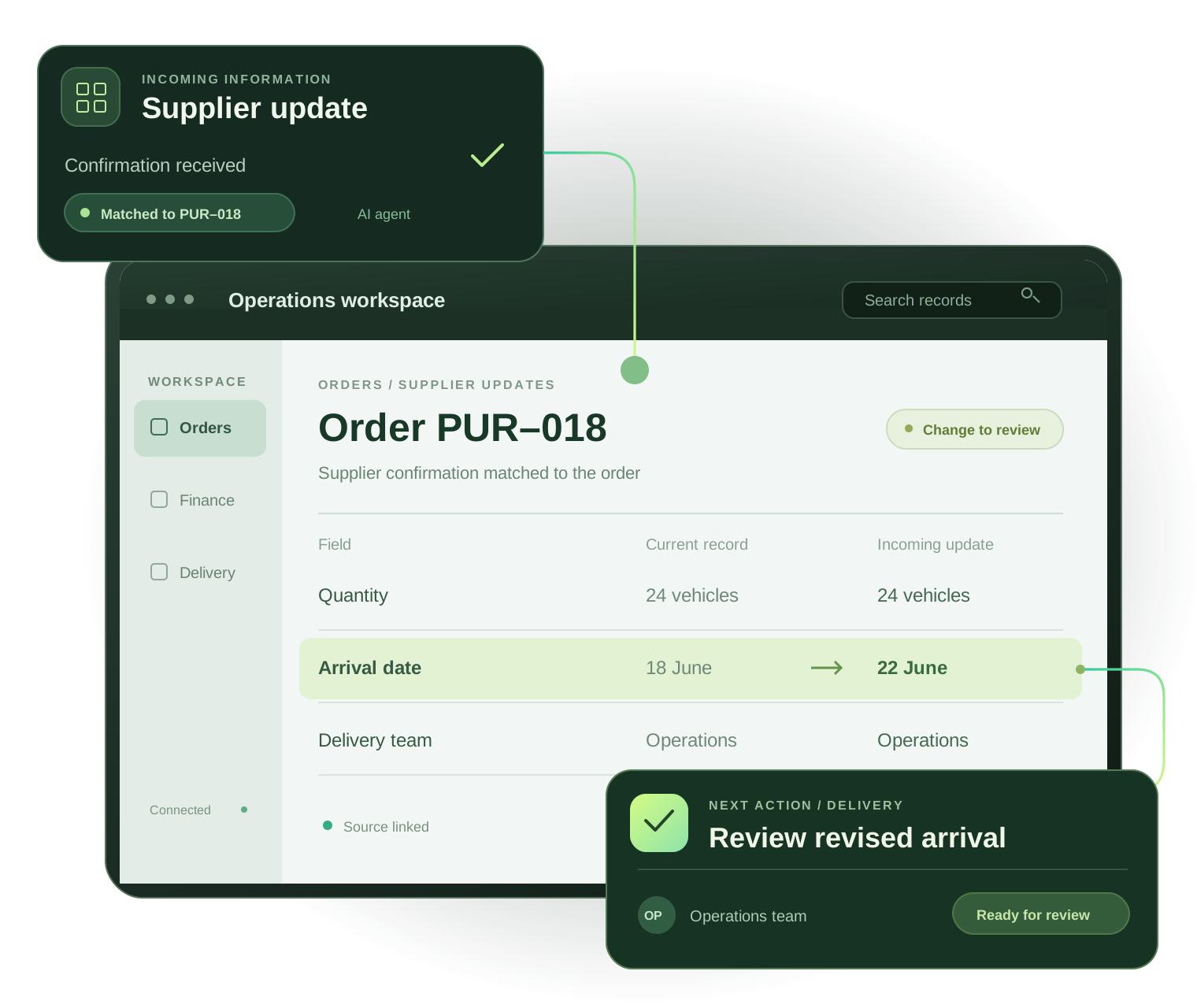
A supplier update becomes a change to review.
Read the incoming information, link it to the right order and highlight what changed. Your specialists review the differences that need their judgement.
- 1Read & identify
- 2Compare with the record
- 3Prepare the update
Purchasing & cash flow
Make a purchasing decision with the context attached.
Bring customer demand, stock, incoming supply and payment commitments into the same view. Compare the operational and financial consequences before committing.
- 1Bring the inputs together
- 2Compare quantities & timing
- 3Review the plan
Delivery coordination
A changed arrival date reaches the people it affects.
Connect shipment updates to the affected orders, vehicles and next handoffs. Suppliers, transport teams, customs, warehouses and dealers work from the relevant information.
- 1Link the shipment update
- 2Identify affected work
- 3Notify the responsible team
Payments & reconciliation
Connect payment evidence to the work waiting on it.
Match bank-transfer information to orders and customer records. Keep partial amounts, missing references and uncertain matches visible for finance review.
- 1Read the transaction
- 2Compare candidate records
- 3Review the allocation
Catalogue & dealer work
Keep product information useful all the way to the offer.
Connect brands, configurations, stock and customer records to the salesperson’s workflow. Prepare offers and commercial documents from the information already in the platform.
- 1Maintain the configuration
- 2Connect stock & customer
- 3Prepare the next sales step

Legacy integration
Improve the workflow while the existing system keeps running.
Connect through available APIs or supported file exchange, using RPA where appropriate. Define record ownership, confirmation and recovery before moving more work across.
- 1Map ownership & interfaces
- 2Connect the workflow
- 3Confirm & recover safely
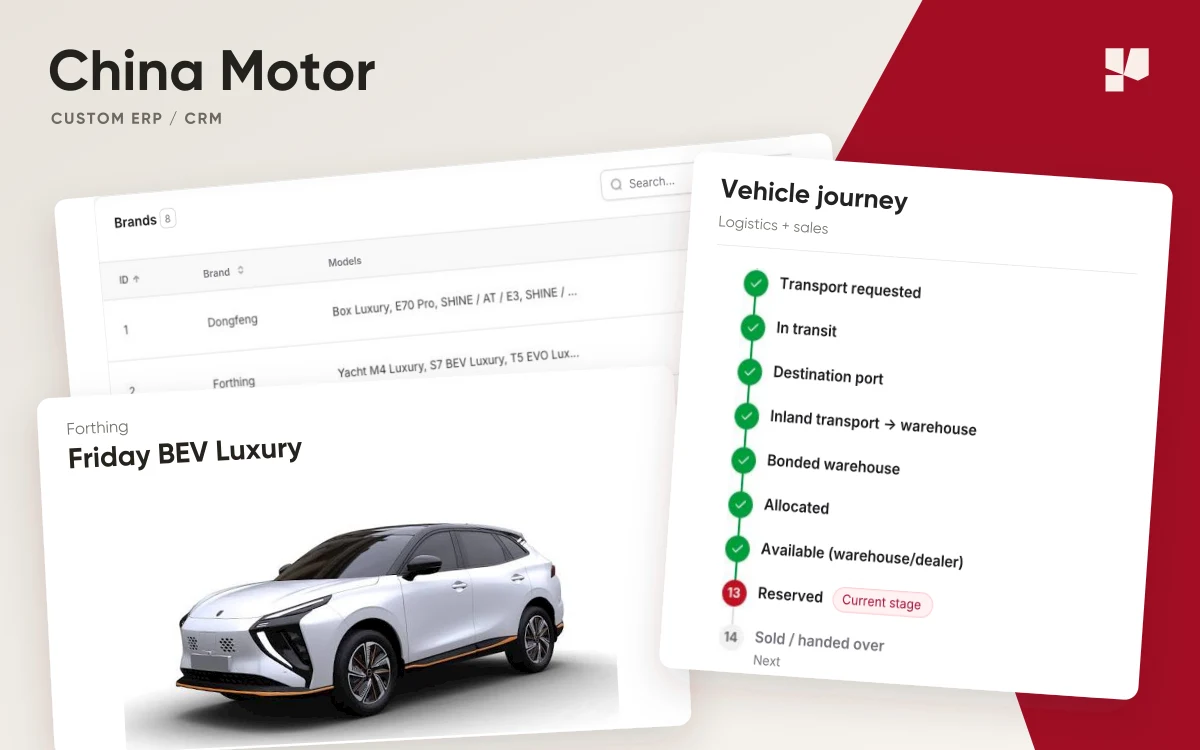
China Motor / Importer & dealer operations
Built into a working business.
For China Motor, we developed a connected platform across document processing, purchasing, vehicle data, dealer sales, finance and aftersales. Information follows the work from the supplier through to the customer.
Explore the China Motor platformHow we get there
Build one useful workflow. Then extend it.
You bring the business context and priorities. We lead design, development, integration, testing and rollout.
- 01
Understand the work
Review the inputs, records, rules and exceptions. Agree a first scope and what a useful result means.
A clear first workflow - 02
Build and validate
Connect the necessary systems and test the complete journey, including uncertain information, permissions and recovery.
A workflow ready for real use - 03
Roll out and improve
Plan migration, train the team and support adoption. Use feedback and operational evidence to decide what comes next.
A supported product that can evolve
A few practical questions.
Do we have to replace our existing ERP?
No. We can connect through available APIs or supported file exchange, and use RPA where appropriate. We define which system owns each record and how errors are recovered before implementation.
Which decisions should AI make?
The workflow sets the boundary. Agreed rules can control routine updates. Uncertain matches, exceptions and important business decisions go to the responsible person, with the source information available for review.
Where should we start?
Choose one complete workflow with repeated manual work. We review its inputs, records, rules and exceptions, then agree a first scope and a way to assess whether it improves the work.
Do we need an internal development team?
No. We lead technical delivery across design, architecture, development, testing, integrations and rollout. Your team supplies the business context and decides priorities; we take responsibility for implementation.