
Custom ERP development
Custom ERP software for the way your business runs.
When spreadsheets and separate systems carry the rules of your business, growth adds more handoffs. We design and build ERP software that connects the work, with the exceptions accounted for.
Let's talk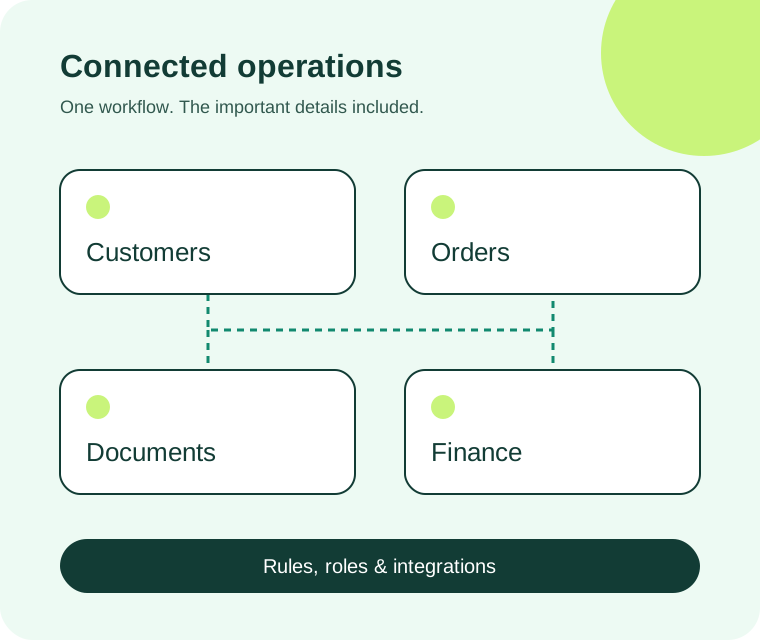
Scope
The rules behind orders, documents and reporting
Start with a complete workflow
Follow a real order through the people, statuses, documents and decisions it depends on. Define the normal path and the exceptions before dividing the work into features.
Connect the systems that should stay
Keep useful accounting and specialist platforms in the picture. Define data ownership, integrations, reconciliation and error handling.
Move from data to daily use
Plan data cleanup and migration, permissions, testing, training and rollout. A system needs to work for the team who will use it every day.
Selected work
The work behind the words

From connected spreadsheets to a custom ERP
ZMatic

Workforce processes beyond spreadsheets
Decathlon Bulgaria
Before implementation
Bring the workbook. We’ll ask about the exceptions.

Follow an order
Include amendments, approvals, delivery and the documents around them.

Read the rules
Review formulas and manual overrides with the people who use them.

Keep useful systems
Decide what accounting and specialist platforms should continue to own.

Plan the handover
Scope data cleanup, migration, training and the first period of use.

The formulas were part of the business
ZMatic’s spreadsheets contained dependencies that had to be understood before they could become ERP workflows. The resulting system brought customer history, orders, reporting and a client portal into one platform.
Your starting material may be a workbook, an export or an approval sent by email. We use those records to uncover the rules the replacement needs to keep. Read the ZMatic ERP case.
Questions before we start
Is custom ERP always better than a packaged platform?
No. A packaged product can be the right fit when its workflows match your needs. We compare configuration, licensing, integrations, migration and long-term change before recommending an approach.
Can we deliver in stages?
Yes, where the workflow and dependencies allow it. The first release should complete a useful operational scope and have a clear boundary with the systems that remain.
What affects the cost?
Business rules, exceptions, integrations, data quality, permissions and rollout requirements matter more than a simple count of screens. We define these before committing to a delivery scope.
Show us the order that needs explaining.
Bring an order, its related documents and the spreadsheet rules around it. We can discuss what belongs in the ERP and what should stay connected.