
The technology should fit the product.


What guides the choice
Fit with the existing system
Consider interfaces, hosting constraints, data and the useful parts of the current software.
Ability to change
Assess maintainability, testing, available expertise and the cost of future development.
Evidence from the work
Use the project case studies to see technologies in context, alongside the problem they helped solve.
Laravel
Laravel gives us a PHP foundation for web applications and APIs, with tools for validation, queues, storage and access control. How the application handles permissions, data and failures still depends on its design and testing.
Web applications and APIs
Background jobs and queues
Authentication and permissions
Integration with business systems

Python
Python is useful for backend services, automation and working with data. Its libraries also support AI and machine learning work. We choose it for the task and the existing environment, rather than treating AI as a feature every product needs.
Backend services
Data processing
Automation and integrations
AI and machine learning libraries

Go Lang
Go is an option for backend services, APIs and command-line tools, including work that needs concurrent processing. We consider the workload, interfaces and the team that will maintain the service before introducing another language.
Backend services and APIs
Concurrent processing
Command-line tools
Network services

Flutter
Flutter lets a team share application code across platforms. For a mobile product, we also check device behavior, offline needs and platform integrations; a shared codebase does not remove testing on Android and iOS.
Shared application code
Android and iOS development
Custom interfaces
Platform integration

React
React helps us build interfaces from reusable components. For business applications, those components need to handle forms, permissions and changing data consistently. Performance and upgrade effort depend on the application; React does not guarantee either.
Component-based interfaces
Forms and interactive workflows
Shared interface patterns
Integration with backend APIs

Selected work
The work behind the words
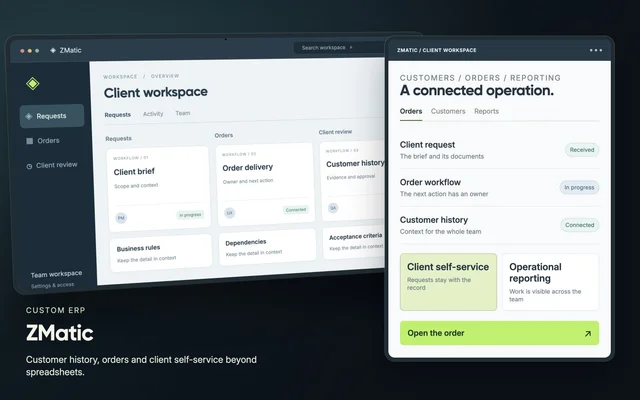
From connected spreadsheets to a custom ERP
ZMatic
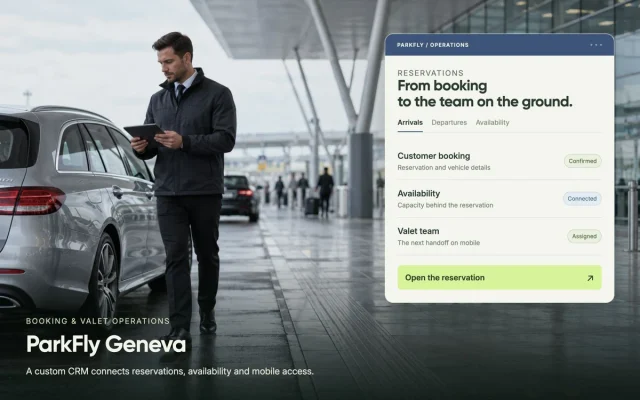
Bookings connected to day-to-day operations
ParkFly Geneva
Already have a stack? Start there.
Show us the current applications and the changes you need. We can assess what to retain before recommending new tools.